
At Loma Linda University (LLU), the School of Behavioral Health (SBH) offers several pathways for students, faculty, and health professionals to engage in global service experiences beyond traditional academic and clinical environments. These opportunities include participation in the International Behavioral Health Trauma Team, involvement in interdisciplinary Students for International Mission Service (SIMS) trips, and global experiences connected to behavioral health training pathways within SBH. While these experiences may differ in structure and purpose, each places participants in settings where learning unfolds through presence, observation, and collaboration with the communities being served. To better understand how these experiences influence clinical perspective and approach, students, faculty, and alumni from SBH reflect on how global service has shaped how they respond in care.
One reflection comes from Dr. Winetta Oloo, Associate Dean for Academic and Student Affairs in the School of Behavioral Health and a member of the International Behavioral Health Trauma Team. She explained that global service is not therapy or counseling in the traditional sense. Rather, it is an immersive experience in which clinicians may provide skills, offer support, and respond in real time to circumstances that require flexibility and thoughtful responsiveness.
Dr. Oloo reflected that working in global service settings grounds clinicians in the realities of the communities they are serving. Through listening, observing, and engaging with individuals in their lived environments, clinicians gain a deeper understanding of the circumstances shaping people's experiences. Through witnessing the resilience of individuals and communities facing adversity, Dr. Oloo shared that global service adds another layer to clinical development. These experiences deepened the sense of hope she carries into her clinical work.
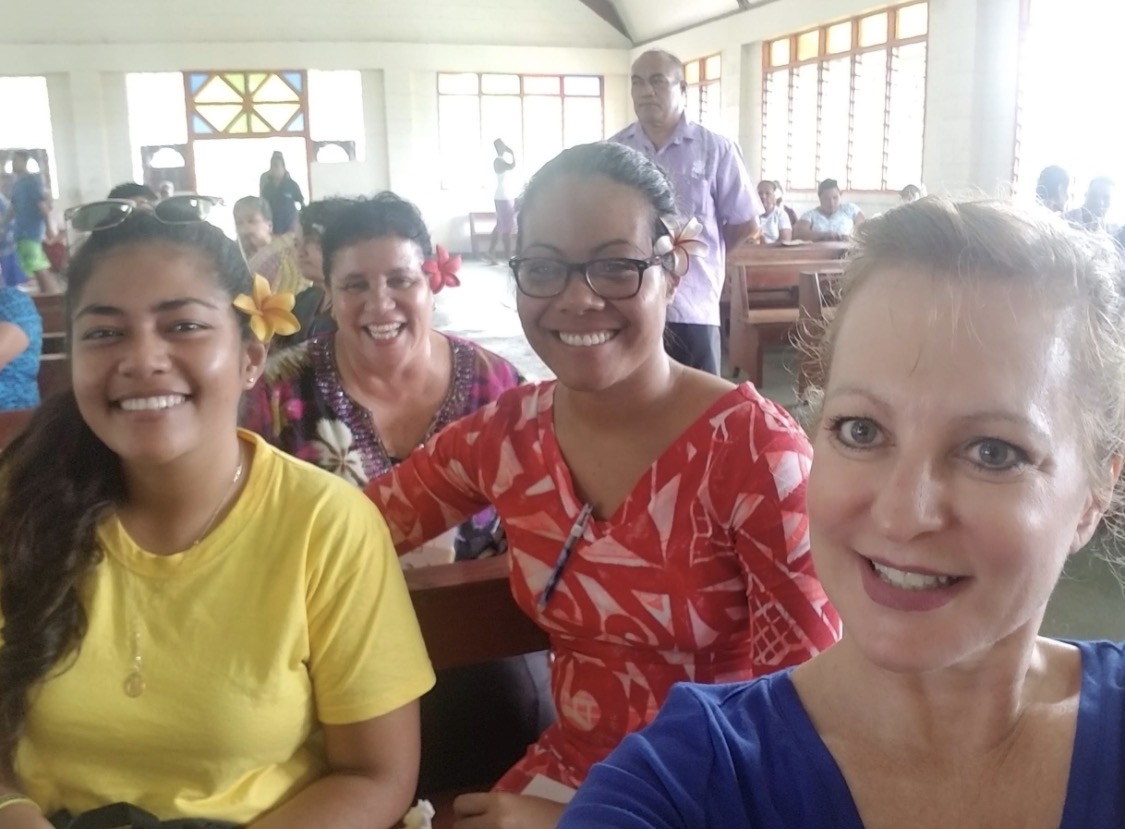
Another reflection comes from Sharon Halter-Day, DMFT-Candidate, a student in the School of Behavioral Health who served on an international trauma team in Samoa. Through this experience, she described gaining a deeper awareness of how culture shapes the ways people make meaning of hardship and healing. She reflected that working within the context of another culture strengthened how she approaches conversations in clinical settings, encouraging her to slow down, listen carefully, and approach differences with curiosity rather than assumption. As Sharon explained, "I became more aware of how meanings can shift across cultures, even when intentions are good. What may be intended as neutral or supportive within one cultural lens can be perceived as judgmental within another."
She also noted that this kind of understanding cannot fully happen in a classroom alone. "Global service taught me that cultural practices cannot be fully understood from a distance. True understanding requires humility, curiosity, and presence."

Agnes Baiju, MSW, MS in Nepal
A similar reflection comes from Agnes Baiju, MSW, MS in Criminal Justice, a graduate of the School of Behavioral Health who served in Nepal through SIMS. Immersion in Nepali culture and conversations surrounding mental health stigma broadened her understanding of how mental health is perceived across cultural contexts. Reflecting on the experience, she shared: "My biggest takeaway is that we should always go to new places wanting to learn more than wanting to teach."
The experience encouraged her to approach global service with humility and openness to learning from the communities being served. As Agnes explained, "Global service should not be about saving; it is about learning, honoring, and partnering." For Agnes, this perspective continues to shape how she approaches conversations about care, reminding her that meaningful support often begins by listening carefully and walking alongside communities rather than imposing solutions.
These reflections show how global service experiences shape clinicians' responses to care. Across these experiences, clinicians described learning to slow down, observe, and remain culturally attuned to the communities they serve. Rather than entering with assumptions, they emphasized the importance of immersing themselves in people's lived realities, listening carefully, and allowing those experiences to guide how care is offered.
In this way, global service becomes more than an opportunity to serve abroad. It becomes a space where humility, curiosity, and presence shape how clinicians approach their work. Through these encounters, the work of the School of Behavioral Health reflects the broader mission of Loma Linda University: to continue the teaching and healing ministry of Jesus Christ.
Interviewed and Written by Audrey I. Perez, AMFT, Systems, Families, & Couples PhD student


