
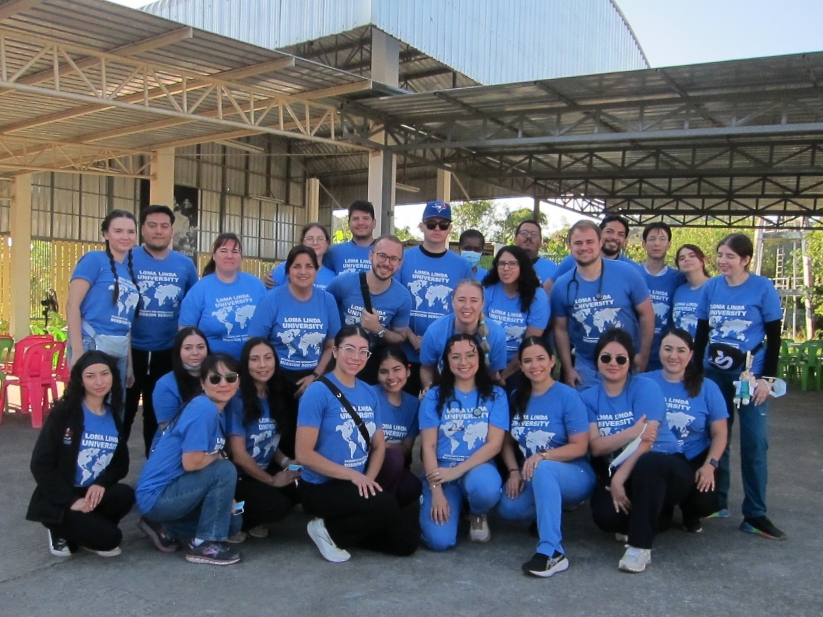
Upon arrival in Thailand, our flight touched down in Bangkok, where I had the opportunity to observe the country's striking contrast between urban and rural landscapes. As the plane descended, I could see lush green farmland and dense rainforest before entering the city. After landing, we were greeted by a Thai couple who served as our tour guides throughout the trip. Our first night was spent in Bangkok, after which we traveled to a rural area for the next three days to visit Bamboo School.
Bamboo School, founded in 2000 by Catherine (referred to as Momo Cat by the children), is not a traditional educational institution but rather an orphanage that provides care for abandoned children. Currently, the orphanage houses 65 children, ranging from infancy to late adolescence. Many of these children have been abandoned due to medical issues, while others have been displaced by the ongoing border conflict between the Karen Hill Tribe and the Burmese government.
The daily routine at Bamboo School is rigorous. The children wake up at 5 AM, participate in morning worship, eat breakfast, and then either attend a local school or complete various chores around the orphanage. Each child is required to contribute to daily tasks, and the buildings at the school are built and maintained by the children themselves. For example, a third-grade boy begins his day at 3 AM, waking early to help lay the foundation for a building until 5 AM, after which he attends worship, eats breakfast, and proceeds to school. Older children are responsible for cooking, caring for younger children, or attending university. The children's lives are marked by a lack of material comforts. There is no internet, television, or toys; their basic needs are limited to food, a bed, and a few sets of clothing.
After gaining insight into the challenging lives at Bamboo School, our next stop was Asia-Pacific International University, where we participated in community outreach activities. Our team set up several service booths, including those offering basic medical triage, such as taking weight measurements, listening to heart and lung sounds, and calculating BMI, as well as mental health psychoeducation, nutrition education, dental care education, and the distribution of reading glasses. In addition, we conducted home visits to assist local residents who were homebound.
My observations in Thailand revealed widespread poverty affecting many communities, particularly in rural areas. At Bamboo School, for example, the living conditions highlight the lack of basic infrastructure. The children do not have access to standard showers; instead, a trash can filled with water is used as a rudimentary bathing system, with a scooper employed to pour water over the body. Thailand also faces significant challenges related to water and sewage infrastructure. It is not customary to flush toilet paper; instead, used paper is disposed of in small trash cans.
By providing basic healthcare, education, and community support, organizations such as Bamboo School and Asia-Pacific International University are not only addressing immediate needs but also empowering individuals to build more sustainable futures for themselves and their communities.
Cultural practices in Thailand also shaped my experience. One key aspect of Thai culture is the practice of removing shoes before entering homes, temples, and certain business establishments. Traditional greetings involve pressing the palms together in a gesture of respect, accompanied by a slight bow. Dress codes are also strictly observed when visiting temples, with visitors required to cover their shoulders and knees, prohibiting shorts, skirts above the knee, and tank tops.
Despite the challenges we encountered, we had a fantastic team and an incredible experience. We enjoyed many delicious and flavorful Thai dishes, although the level of spiciness often exceeded my tolerance. We also had the opportunity to visit the Thai Elephant Conservation Centre, where we were able to pet, feed, and bathe the elephants. While some participants opted for massages or scuba diving, I chose to participate in jet skiing and an ATV adventure.
The simplicity of life in Thailand, focused on survival and basic sustenance, contrasts sharply with the material excess often celebrated in wealthier societies. This contrast highlights how contentment can be found in meeting basic needs rather than pursuing luxury. This experience profoundly reshaped my understanding of what it means to live with less and emphasized the importance of appreciating what we often take for granted.
Moreover, the trip reinforced the critical role that service and outreach play in addressing the systemic issues that perpetuate poverty. By providing basic healthcare, education, and community support, organizations such as Bamboo School and Asia-Pacific International University are not only addressing immediate needs but also empowering individuals to build more sustainable futures for themselves and their communities.
Overall, this trip deepened my sense of empathy and global awareness. It provided invaluable insight into the stark realities faced by impoverished communities and the resilience of those living in such conditions. It has motivated me to explore future opportunities in global service or nonprofit work, with the goal of contributing to ongoing efforts to alleviate poverty. This experience served as a humbling reminder of the power of service and the lasting impact of even the smallest acts of kindness.
I am deeply grateful for the unwavering support and generosity of the Loma Linda University School of Behavioral Health in making this trip possible.
Written by Deanna Tang, Master of Social Work (MSW) student, after participating in a Loma Linda University Students for International Mission Service (SIMS) trip in December 2025


