
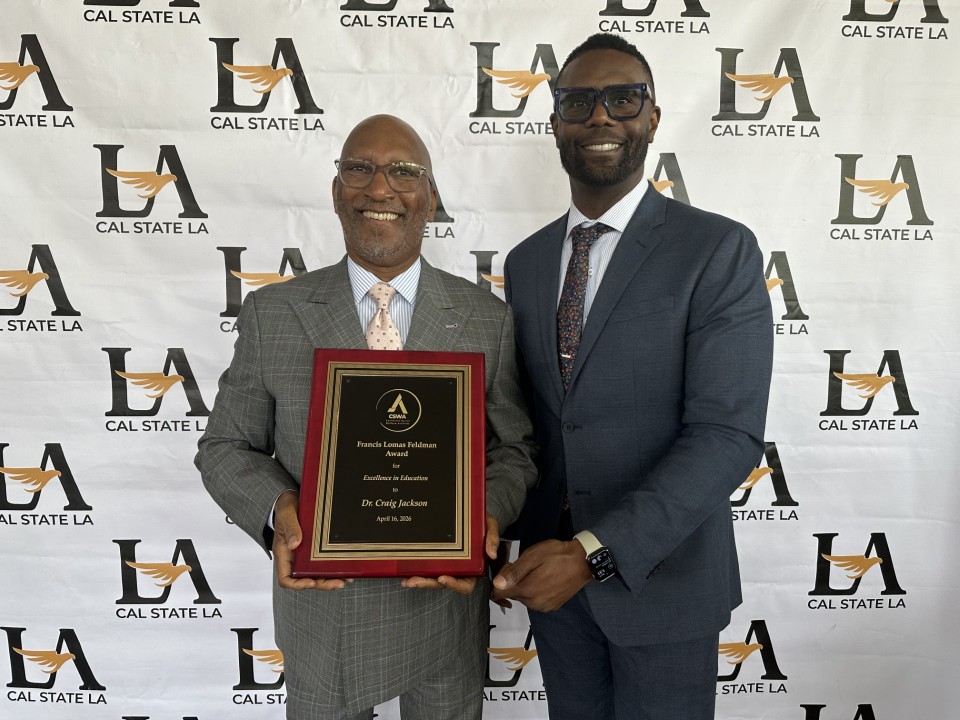
The Frances Lomas Feldman Excellence in Education Award is part of the California Social Welfare Impact Awards. Named after Frances Lomas Feldman, a pioneering social worker, educator, and researcher whose career centered on social policy and administration, with a focus on families, work, and the systems that shape everyday life, the award recognizes individuals whose contributions to education have had a meaningful and lasting impact.
Craig R. Jackson, MSW, JD, currently serves as Dean of the School of Allied Health Professions at Loma Linda University and was selected to receive this award following a nomination from a former student he taught in the social work program in the 1990s. The award was presented at the California Social Welfare Impact Awards luncheon, where Dr. Jackson was formally recognized for his contributions to education. The nomination from a former student he taught decades earlier reflects a lasting impact that continues to extend across generations of learners, even as his roles have evolved.
His connection to Loma Linda University spans over four decades, beginning in 1982 when he started as a clinical social worker in pediatrics at Loma Linda University Medical Center. From there, his work expanded into program leadership, including serving as director of an outpatient drug and alcohol clinic, and later returning to the medical center as Assistant Director and then Director of Social Work. After completing his law degree, he transitioned into academia in the early 1990s as one of the founding faculty members of the social work program at Loma Linda University, before later stepping into his current leadership role.
Dr. Jackson describes leadership as selfless, focused on promoting the best interests of others, and working toward outcomes that make things better.
Dr. Jackson earned his B.S. in Psychology from Wayne State University in Detroit, Michigan ('73), his Master of Social Work with a clinical focus ('76) from the same institution, and his Juris Doctor from Western State University College of Law in Fullerton, California ('93). Over time, these areas have come together in the way he approaches education and leadership. As part of the founding faculty of the social work program, he contributed to the integration of law, ethics, and bioethics into the curriculum, drawing from both his clinical and legal background at a time when these areas were not widely emphasized in behavioral health education.
His clinical and direct practice experience in social work, combined with his legal training, shaped how he approached teaching, leadership, and collaboration. He focused on helping students build not only clinical understanding, but also confidence in navigating systems such as law and policy, knowing when to act, when to consult, and how to think through complex situations with clarity.
In his current role, Dr. Jackson's work takes place largely behind the scenes, reflecting a shift from direct teaching to broader leadership within the institution. While the setting of his work has evolved, his approach has remained consistent, centered on supporting others, guiding systems, and creating meaningful change. He describes leadership as selfless, focused on promoting the best interests of others, and working toward outcomes that make things better.
Receiving the Frances Lomas Feldman Excellence in Education Award holds deep meaning for Dr. Jackson, not only as recognition of his contributions to the field but as a reflection of the relationships he built along the way. That the nomination came from a former student, years after their time together in the classroom, speaks to the kind of impact he has long worked toward. He shared that he feels both honored and humbled to have been part of their professional journey, and that knowing his influence continues to resonate across generations of learners means a great deal.
Interviewed and Written by Audrey I. Perez, AMFT, Systems, Families, & Couples PhD student